Tuesday, January 21, 2014
From Todd @ Juno Bait -Juno Beach
Catch 365
"Handle with Care"
A fishermen is no better than the bait he is using; so always be sure your baits are in the best condition. Try these tips to keep your baits lively and fresh.
1. Avoid chasing your baits around the livewell numerous times;instead let them swim into a bait net.
2. Always handle baits with wet hands; or a wet towel for bigger baits.
3. Be careful about overcrowding them in a livewell. Less baits in good condition is much better than more baits in poor condition.
"Start em young"
Nothing beats taking a kid fishing(especially for the first time!). The keys to a great first trip and a lousy one are pretty simple. Follow these couple tips and most of the time a kids first fishing trip is one they won't forget!
1. Don't take it to serious, and don't worry if their patience level is only a few minutes.
2. Try to pick an easy to catch species to target. KIds, most of them anyways, don't care what they catch. They just want to catch SOMETHING.
3. Make it fun and keep smiling. If the fish aren't biting and swimming or playing in the park sounds like more fun, do that; the fish will be waiting for you next time!
From Whites Tackle - Ft Pierce / Stuart
The Spanish bite has been good around the inlet in the schools of bait with a few blues mixed in. Inshore the snook fishing has been steady in the inlet and around the bridges on jigs. There has been a few scattered pompano around the sailfish flats.The trout fishing has been steady back to the around midway road and the power lines. Snook season is just around the corner so come stock up on jigs and stuff don't wait till the day before.
Friday, January 17, 2014
Frontal Assault- Flats Fishing After a Cold Front
A Special Report by Capt. John Kumiski
The wind blows from the south under a gray sky. A squall line approaches from the north. That south wind dies. It’s eerily calm.
Suddenly a frigid blast comes from the north. Rain lashes, whitecaps crash, the temperature drops 20 degrees in seconds.
A common winter phenomenon, a cold front has just passed through. How does the passing of a cold front affect the flats fisherman?
Unlike you, fish are cold blooded. A fish’s body temperature hovers within a degree or two of their surroundings. Redfish prefer 70 degree water. Spotted seatrout like it between 70 and 75 degrees.
As temperatures get below that their metabolic processes slow. They need less food. Get near the extremes of their tolerance and they become lethargic. Another degree or two colder and they die. We saw this demonstrated three winters ago during that extended cold snap. Dead fish were everyplace.
During the winter months, water temperatures in our local lagoons rarely get as warm as the fish prefer. Our finned friends seek water temperatures as close to their preferred range as they can find. Since shallow water warms (and cools) more quickly than does deep water, when conditions are right the shallows will be full of fish.
Right after a cold front passes the conditions are not right.
The passage of the front causes the air temperature to drop, which in turn lowers the water temperature. This drop in water temperature is exacerbated by a strong northwest wind, often at 20 to 25 miles per hour with higher gusts. An interested observer can stand on the bank at the north end of the lagoon system and over the course of several hours literally watch the water level drop as the wind blows the water to the south.
Fishing the flats during these conditions is a complete waste of time. The fish have moved to thermal refuges where their bodies can better adjust to the falling water temperatures. In the deeper water the temperature will still drop, but it occurs more gradually. This causes less shock to the fish.
These thermal refuges include canals, dredge holes, power plant outflows, and perhaps the Intracoastal Waterway channel. Just the mass of water in these types of places supplies some insulation and moderates the temperatures.
If you find a concentration of fish in this situation fishing can be ridiculously easy. The fish don’t find much in the way of groceries in these types of places, though. The groceries are up on the flats.
This brings us back to a statement made above: when conditions are right the shallows will be full of fish. What are those conditions?
A strong front has passed. Daytime highs have been in the 50s, nighttime lows in the 30s. The wind has been howling out of the northwest at 20 or so. And then, it stops blowing. The sun is out. No wind. No clouds at all. Go fishing. Now. Let nothing stop you.
Solar radiation quickly raises the temperature of shallow water three of four degrees. The fish, all of them, have been trapped in deep water for two or three days, with nothing to eat. The fish, all of them, come swarming up onto the flats to sun themselves, to get warm, to find food. Be there that first day the weather moderates and you could have the best fishing of the year.
Subsequent days are never as good. I don’t know why not, but I have observed it for years. Sunny days when the wind still blows are not as good. I don’t know why not, but I have observed it for years.
Now, understand that the fish are hungry but the water is still below their preferred temperature. They will eat but generally they prefer smaller meals. Shrimp and crabs are easier for them to digest then smaller fish. Smaller, darker colored baits seem to work better in this circumstance than large or brightly colored baits. Experimentation is still the name of the game, though. If I were a fan of large, brightly colored baits that’s certainly what I would try first.
Redfish and seatrout behave differently. Seatrout will usually be sunning themselves over white spots surrounded by seagrass. Where you find one there will usually be a bunch. These are big fish, 24 inches and over. I don’t know where the little ones go, nor do I care.
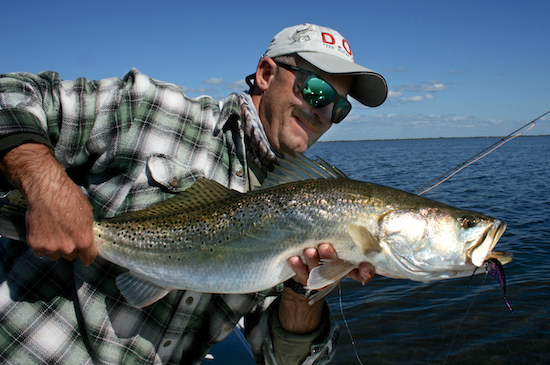
Under these circumstances it’s possible to sight fish for big trout, hard to do the rest of the year. The fish, lying in shallow water, are very spooky. The splashdown of something as small as a Clouser Minnow spooks them every time. If fly fishing, an unweighted streamer or a quiet surface fly like a gurgler or slider works well. Spin fishermen would use a soft plastic bait like a four inch jerkbait or a DOA Shrimp, casting beyond the sandy hole and reeling the bait over it.
If you spook the fish they’ll move, but generally will stay in the area. After resting them you may get another chance.
Redfish offer a wider range of behaviors. They could be tailing. They could be cruising. A cruise may be parallel to a shoreline (the fish may have its back out of the water) or may be a circular route, in to shore and back out, then back in again.
They could be singles, or in schools of hundreds. They could be laid up on white spots too, although this is not usually a good thing. You want to see them active and feeding.
In our lagoons if you spook a redfish, or a school of them, the game is usually over. When they’re aggressive after a front passes though, that may not be true.
When fly fishing try shrimp or crab imitations. Spin fishermen should try small jerkbaits, jigs, DOA Shrimp, or the always reliable Johnson Minnow.
Some fishermen curse cold fronts. I love them. My ideal winter would see one pass through every week, keeping the fishing on fire for the entire season.

Sebastian Inlet Report


01-17-14 FRIDAY: BLACK DRUM, SHEEPSHEAD, SPANISH MACKEREL, BLUES, MARGATE, POMPANO AND SEA TROUT
It is a beautiful morning at the inlet. It's in the 40's but we have blue skies, the water has a light chop and winds are blowing out of the Northwest at 7 mph, gusting to 12. The bite has been very good the past couple of days. Black Drum, Sheepshead, Spanish Mackerel, Pompano, a few stragglers of Margate, Blues and unusual catches rounded out the mix. Sea Trout have been active on the flats. Black Drum, Whiting, Croakers and Pompano have been landed from the beaches.
We received an update from Mike Ricciardi of Vero Beach who fished the north jetty again yesterday. He arrived later than usual, 10:30 a.m. and reported another good day for Black Drum. The bite was good prior to his arrival and continued until about 1:30 when the tide changed. Mike limited out with five, 25", 23", 21", 20" and 19". Mike said about 25 - 30 Drum came over the rails during his time on the jetty. Clams and shrimp were producing the best results.
Our first photo today features Sally Baughman of Jackson Hole, WY with some nice Pompano that were landed. Sally landed two of them, all were caught on clams.
Ron Castillo and Tony Swiderski of Sebastian and Mike Ricciardi of Vero Beach are featured in our second photo with Black Drum they landed yesterday. Tony also landed a Pompano.
Arnold Avila of Davenport had very good luck fishing from the north jetty. Arnold landed 4 Black Drum, 4 Sheepshead, 1 Margate and a few Spanish Mackerel using clams and shrimp.
Our fourth photo today features Jose Pina, Frank Rivera and Fortuneto Santos of Poinciana. The trio landed 11 nice Black Drum between them using shrimp/clam combos.
From Capt. Charlie @ Fishing Center - Ft Pierce
Winter weather has certainly found a resting place on the Treasure Coast this week. The latest cold front brought some nights in the 30's and 40's to the area. It appears that we are going to get our share of cooler weather this winter, along with lots of windy days. Water temperatures are going to take a big dip for several days, but there are plenty of good areas to enjoy some fishing. The incoming tides will bring warmer water in from the ocean. Try to find where the water is a few degrees warmer than the surrounding area. When the water is cold, it's not necessary to be out there at first light. Sometimes the bite is better later in the day. Just make sure you bundle up good.
Deeper water has been very productive for a variety of species the past several weeks. On windy days, you can find areas like the turning basin in Fort Pierce that has a large variety of fish. Lots of mackerel, snapper, sheepshead, jacks and blue runners can be caught in the channels around the inlet in 8-15 feet of water. Small shiny lures work great on all these fish. I would expect colder water this next week, so areas like this will be the most active spots.
Docks will be holding black drum, sheepshead and some redfish. As the sun rises, you will find fish moving onto the flats to soak up some warmth and get active later in the day. Trout and redfish will sit in the sand holes to warm up and feed. Try artificial lures like CAL jerk baits, Deadly Combos or DOA shrimp in the sand holes of the flats as the sun is higher. Work your lures or baits very slowly for your best chance. Fish will be lethargic now and not willing to move quickly. They are trying to save energy and warmth and aren't as likely to strike. Try drop offs where the water is deeper along the channel edges. Mangroves can also be warmer than the flats. Fish those that are deeper to find fish hanging under them. Fishing in winter can be rewarding for those who are willing to work at it. I have had some of my best redfish days in the middle of winter.
The surf has been alive with whiting, croakers and some pompano this past week. Anglers there are catching them in good numbers. Look for more pompano and bluefish to be showing up in the river now. They like the cooler water conditions. Some flounder are being taken off the south jetty in Fort Pierce this week. Look for lots of fish filtering into the inlet on the incoming tides. Fishing is good this time of year if you change tactics or target wintertime species. Have fun and enjoy the fishing!
Deeper water has been very productive for a variety of species the past several weeks. On windy days, you can find areas like the turning basin in Fort Pierce that has a large variety of fish. Lots of mackerel, snapper, sheepshead, jacks and blue runners can be caught in the channels around the inlet in 8-15 feet of water. Small shiny lures work great on all these fish. I would expect colder water this next week, so areas like this will be the most active spots.
Docks will be holding black drum, sheepshead and some redfish. As the sun rises, you will find fish moving onto the flats to soak up some warmth and get active later in the day. Trout and redfish will sit in the sand holes to warm up and feed. Try artificial lures like CAL jerk baits, Deadly Combos or DOA shrimp in the sand holes of the flats as the sun is higher. Work your lures or baits very slowly for your best chance. Fish will be lethargic now and not willing to move quickly. They are trying to save energy and warmth and aren't as likely to strike. Try drop offs where the water is deeper along the channel edges. Mangroves can also be warmer than the flats. Fish those that are deeper to find fish hanging under them. Fishing in winter can be rewarding for those who are willing to work at it. I have had some of my best redfish days in the middle of winter.
The surf has been alive with whiting, croakers and some pompano this past week. Anglers there are catching them in good numbers. Look for more pompano and bluefish to be showing up in the river now. They like the cooler water conditions. Some flounder are being taken off the south jetty in Fort Pierce this week. Look for lots of fish filtering into the inlet on the incoming tides. Fishing is good this time of year if you change tactics or target wintertime species. Have fun and enjoy the fishing!
Thursday, January 16, 2014
From Todd @ Juno Bait -Juno Beach
Catch 16/365
"Pro Style Pompano Rigs"
From "Pompano Rich" Pompano Catcher Rigs were formulated to attract pompano in various water conditions. The colors and the buoyancy flutter with good wave action to virtually drive pompano to hit the flea float combo. Add fluorocarbon leader and the visibility of rig disappears under water. The float colors are varied to meet different water conditions. Years of optic studies have revealed many species of fish see colors, and under the right conditions will be attracted to them. Two important tips. 1. If you use braid; you should not tie directly to the swiveled rig. Braid is highly visible and will negate the rigs attraction. If using braid attach approx. 10 ft. of mono or fluorocarbon in around 30 l.b. test to the rig and then use a surgeons knot to connect to the braid. 2. Fill the hook with bait. A one inch blanched flea is fine but one small 1/2 flea is not enough. |
Sebastian Inlet Report


01-16-14 THURSDAY: BLACK DRUM, POMPANO, SHEEPSHEAD, SPANISH MACKEREL AND WHITING
Hang on to your hats anglers; we have a blustery morning at the inlet. Winds are blowing out of the Northwest at 23 mph and gusting to 28. There is a small craft advisory in effect through late this evening. Always check the NOAA forecast prior to going offshore. The NOAA forecast can be found under our first photo on the live web cam page. We are aware that the anemometer is not operating properly this morning and we are investigating the matter. It's a cool morning, but we still have at least 10 frost-proof, windproof people out fishing. When the bite gets good, there's no keeping them away.
We received an update from Mike Ricciardi of Vero Beach who fished the north jetty yesterday morning. Mike arrived at 6:30 and reported a slow bite for the first few hours. Pompano started hitting around 9:00 a.m. on the high tide and close to shore. Quite a few anglers moved to the south beach where Black Drum, Whiting and Croakers were active as well. Mike reported between 18 - 20 slot sized Pompano came over the rails between 9:00 - 12:00. Anglers using live shrimp and clams were nicely rewarded. Mike landed three, but some anglers met their limit of 6. After the tide turned to outgoing, the Black Drum bite turned on and a lot of large to medium sized fish came over the rails. Chuck Fischer of Satellite Beach landed three, a 27", 23.5" and an 18". Tony Swiderski of Sebastian had three and was still fishing when Mike left. Clams and dead shrimp were working well for the Drum. I spent an hour on the north jetty from 2:30 - 3:30 and there was lot of activity going on. Black Drum were coming over the rails quite often, Sheepshead and Spanish Mackerel were all in play. Some anglers had been there all day and Glenn Jenkins of Orlando did well with Black Drum, Sheepshead and some large mullet. Glenn reported that large schools of mullet came through early in the morning. Others were landing Spanish Mackerel and a Margate or two. Yesterday was a pretty good day at the inlet.
Our first photo today features David Blanchette of Norfolk, VA with a good sized Black Drum he landed on the south beach. David was here visiting his parents for the weekend and landed two good sized Drum using frozen clams.
Our second photo is of Mike Ricciardi of Vero Beach with three Pompano he landed off the north jetty yesterday morning.
Trudy Hopper, a one year resident of Sebastian landed this pretty little fish off the T-Dock and was unsure of what it was, so she sent it to us to identify. We initially thought it was a Green Wrasse, but we sent it to our go-to guy, SISP Ranger Ed Perry. Ed said it is a Halichoeres bivittatus, more commonly known as a Slippery Dick.
Glenn Jenkins of Orlando is featured in our fourth photo today. Glenn poses with two Sheepshead of many fish he landed yesterday off the north jetty.
Robert Pumarada sent in our last photo today of his friend Gherzon who had his first Shark encounter at the inlet. Robert, Gherzon and Gonz Sumayang were out Monday morning and reported a beautiful day, but the bite was slow. Gherzon landed and released this juvenile Shark, but we can't tell if it's a Bonnethead or a Hammerhead, nor could our go-to guy, due to the angle.
Subscribe to:
Posts (Atom)